New in the Shop!

Showing posts with label Tutorials. Show all posts

Wednesday, June 5, 2013

Sweater Shoulder Surgery Success!

About a year ago I showed off my Monami Cardigan. It's a beautiful pattern, but my attempt had a few serious flaws. I never did fix the overly small shawl collar, because I decided that some things aren't worth the effort and it didn't need to fold over after all. The worst fit problem, however, was this weird shoulder poof in the sleeve right at the top of the armscye. I wasn't sure what caused it, and I assumed it was because I did a poor job of setting in the sleeve or because the sleeves were too narrow for my arms.

I was watching episode 79 of the Stockinette Zombies Podcast and Amy's new cardigan had the same problem! They discussed possible causes and solutions - and it turned out that row gauge was the culprit in my goofy shoulder problem (I think the shoulders were too wide at the seam as well, which made it impossible to hide the sleeve lump). The sleeve piece just gets way too tall as it narrows, meaning it can't fit in the armhole. It looked like ripping back was the only real option - so, on a whim, I did!

I started by cutting the yarn that seamed the pieces together and opening up the shoulder to just below where the excess sleeve fabric began. I inserted a dpn along a row of stitches at the right height and ripped back to that point.

You can see in the picture how much area the excess fabric had taken up. A lot.

Also - yarn ramen!

Then I simply bound off the sleeve stitches and seamed the shoulders shut again, lining the centre of the sleeve back up with the shoulder seam.

The new silhouette is a little more drop-shouldered than set-in, but the fit is fantastic.

Also, you get to see my dingy bathroom. You lucky duck.


Wednesday, May 4, 2011

Tutorial: DIY Yarn Swift for under $15, and some helpful links!

I decided (in lieu of my normal Wednesday links) I'd share a tutorial for my awesome DIY yarn swift, as well as the links to the projects that helped me arrive at my final product. This swift combines all the best attributes of the other DIY swifts I liked, without as many setbacks. It's sturdy as heck, spins on ball bearings, adjusts to hold a skein as small as one yard or bigger than three yards (this was a requirement specific to my large skein niddy noddy - enormous skeins are great for dyeing), can be disassembled for storage, and cost me about $12.


Get the tutorial and links after the jump!

Thursday, April 7, 2011

How To: Turn a Desk Calendar into a Wall Calendar - Framing a Book!

I've been using a day planner for years now, but lately I've learned that I am not the only one in this family that needs a little help staying on top of daily planning. However, keeping a wall calendar is no good, because the little squares are way too tiny to write much of anything in. I'm not into the look of those giant wall calendars with the dry erase pens. I like organization, but not that much. Thus I decided to convert my beloved desk calendar into a wall calendar the whole family can use.


 Ours is mounted on the wall, but it's in the dark, ugly grotto next to the door, so I photographed it resting on a shelf.  Where, I might add, It looks awesome.


Get the tutorial for a wall mounted desk calendar, and for the mods to safely prop it on a shelf in the long term, after the jump!

Monday, March 21, 2011

How to: Make a Flower from Recycled Knitwear

Remember that sweater vest that I made into a dress for Rei? Well, it also yeilded a pretty fabric flower!


I love this - it has a wonderfully distressed yet feminine edge, and it's so versatile! I still haven't decided if it wants to be a hair bow, a brooch, a purse accessory, part of a necklace, or an accent on a dress. Currently, it lives on my desk, waiting for the perfect home.

Get the tutorial after the jump!

Tuesday, March 15, 2011

How To: Make a Baby-Sized Play Dress from an Old Sweater Vest


Jake is a sweater vest wearer. This is awesome, because I think he looks super hot in them. However, he's hard on his clothes and they do get in pretty rough shape, pretty quickly. I decided to give one of his vests - 100% cotton with a great big hole in a seam that wasn't worth fixing - a second life as a play dress for Rei, and I thought I'd share my pattern drafting and dress making tutorial. Just so you know, this isn't a recipe for a pretty party dress, it's a comfy, cosy, hard-wearing little number; made for a little girl who is almost as rough on clothes as her daddy is.

Get the how-to after the break!

Saturday, March 12, 2011

How To: Make an Oilcloth Picnic Mat for your Toddler


I don't know about other one-and-a-bit-year-olds, but Rei has an almost ridiculous independent streak. It's only gotten more pronounced as she's learned to walk. Sometimes getting her to eat can be an enormous battle of wills. I've found that allowing her to eat her snacks a little more on her own terms gets a lot more healthy food into her belly. She's much more likely to eat sitting on the floor with her toys than strapped into her booster chair. With the cleanliness of my carpet, and thus my own sanity, in mind, I whipped up this cute little oilcloth picnic mat for her to sit on. It's great indoors and it will keep her snacks free of dirt in the summer months when we are out in the yard!


Want to make one? It's easy - a perfect beginner project! What I did, after the break....

Thursday, February 17, 2011

How To: Make Chocolate Butterfly Cake Decorations

A few weeks ago my friend Chie taught me how to make chocolate butterflies, and from that moment I knew Rei NEEDED butterfly cupcakes at her first birthday party. Chie found the idea at cookpad.com, but the instructions are lost on me - the whole site is in Japanese! I thought I'd write up a tutorial myself, in English, for those of us who don't have the good sense to be multilingual.

Pretty AND delicious!


Learn to make easy, fast, and beautiful chocolate butterflies after the jump!

Friday, December 17, 2010

Star Wreath Tutorial

Do you (or someone you know) get a real Christmas tree each year? Mmmmm that smell...
Do you buy one that is much too tall for your ceiling?
Do you have to cut part of the top off to make it fit, and then manicure what's left of the top so it doesn't end in an unspectacular tree-plateau?

This happens EVERY YEAR at my parents' house. I took the manicure trimmings home to see if they could be put to some use, and I came up with a simple, practically free wreath that I just love. Look at it! Don't you want one?


Isn't it sad that I don't even have an available door to hang this on?

Monday, November 29, 2010

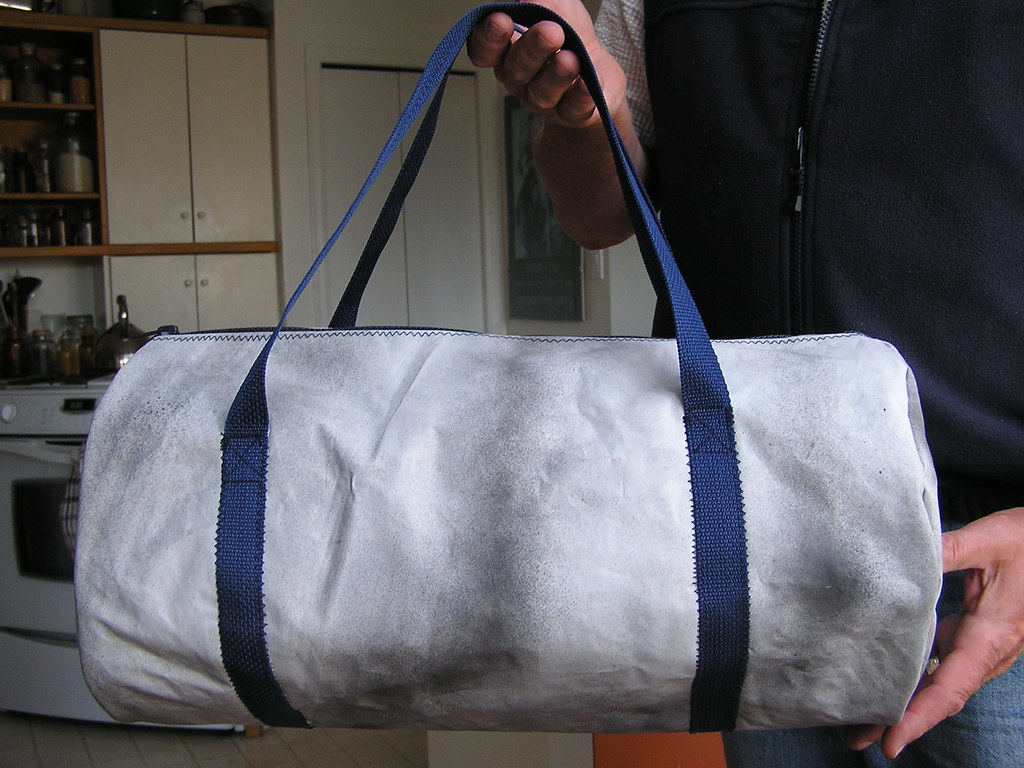
Extra Awesome DIY Recycled Duffel Bag Tutorial

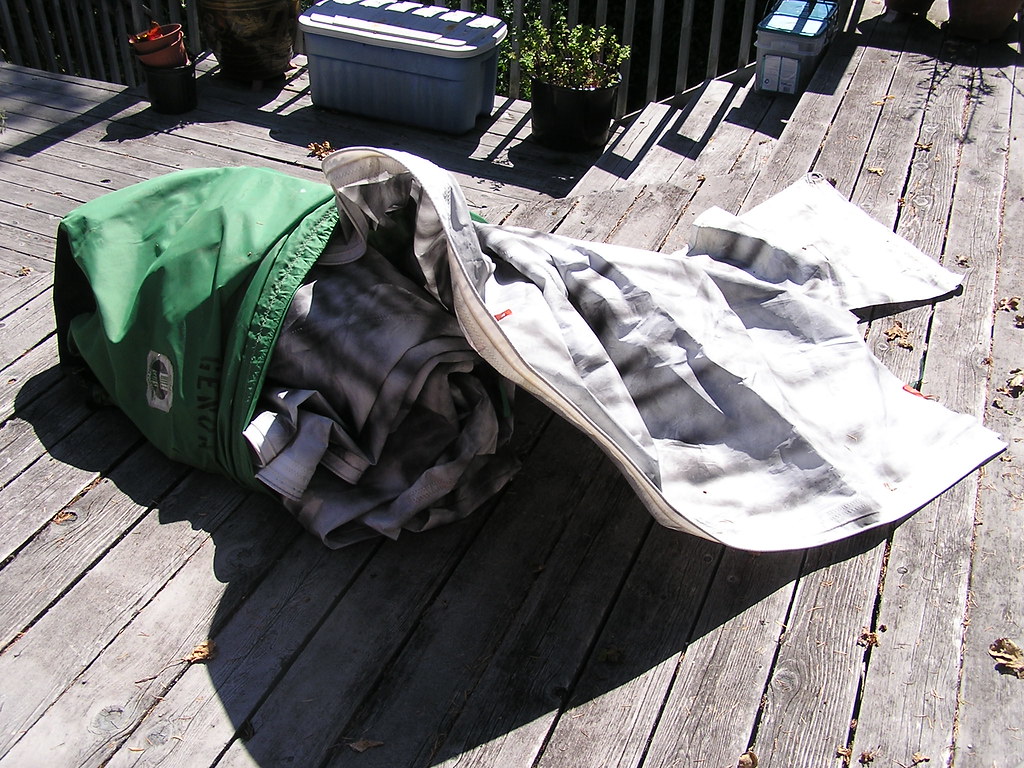
I think the title really says it all on this one. My dad had an old sail that was no longer in use, and he commissioned me to turn it (well, a tiny fraction of it - there's a LOT of yardage in a sail) into a few duffel bags for his sailing gear. If you live near a large body of water (or perhaps even if you don't) you may have access to used sails - see if there is an exchange or something at a marine shop. Maybe you can get one on the cheap that has ripped. All sails are not made alike - different high tech textiles serve different purposes. Some are papery and almost translucent, others are sturdy and don't bend easily. Sometimes they are brightly coloured. The sail I used was on the sturdy end of the scale, yet is still light. It's woven, but doesn't fray. It's extremely strong, but somewhat prone to ripping along seams. All in all, it's a really awesome find and I can hardly wait to be done making all the Christmas stuff so I can play with it. It did get spray painted black (pirate costume... not mine... don't ask) at one point, which isn't beautiful, but I like it anyway.


No sail? You could recycle the leaky old canvas tent in your uncle's garage, or a car cover you no longer have a car for, or whatever you want. It just needs to be strong stuff.

So, stop blathering and on with the tutorial right?

The smaller bag, with pockets on the inside.

Tuesday, September 7, 2010

Something to Show

Hi!

I've been more than a little absent from blogland lately. Sorry. Like I said last post, Christmas presents kinda kick my ass time-wise, but I really love making them so I let the non-essentials slide. Yep, blogging is a non-essential. Unless it starts making me money that is; then I will blog till my fingers are blistered and my brain is empty.

Another problem with spending most of my creative time on presents is that I can't show them off when they are finished. It's terrible - I'm really proud of a few of the things I have made (6 completed items so far!) but right now it's all a big secret in case someone stumbles across their future gift.

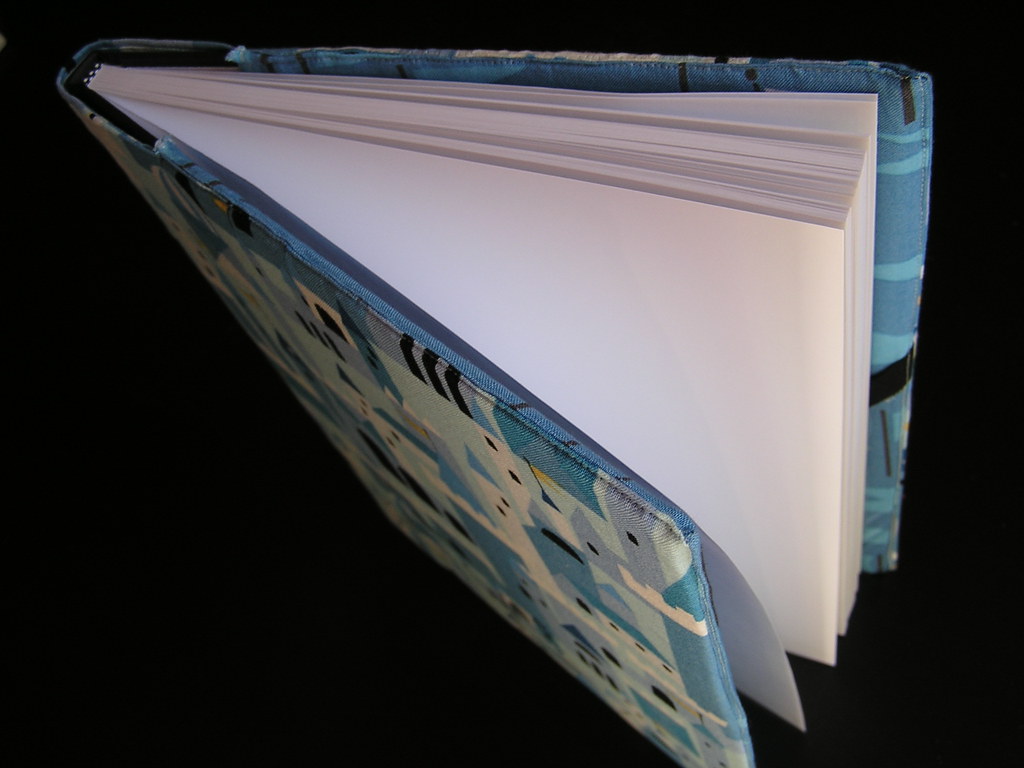
One present that I am able share is a part of my sister in law K's Christmas present. She is on a mission for the LDS church right now and is therefore unable to see most of the interwebs, including this bloggy backwater. K is awesome. I don't know if she knows I think that - I guess I should write her and tell her. She's a really cool person and I wish I knew her better. She is a fantastic artist, and all the artists I've ever met need sketchbooks, so I made a book cover for her.


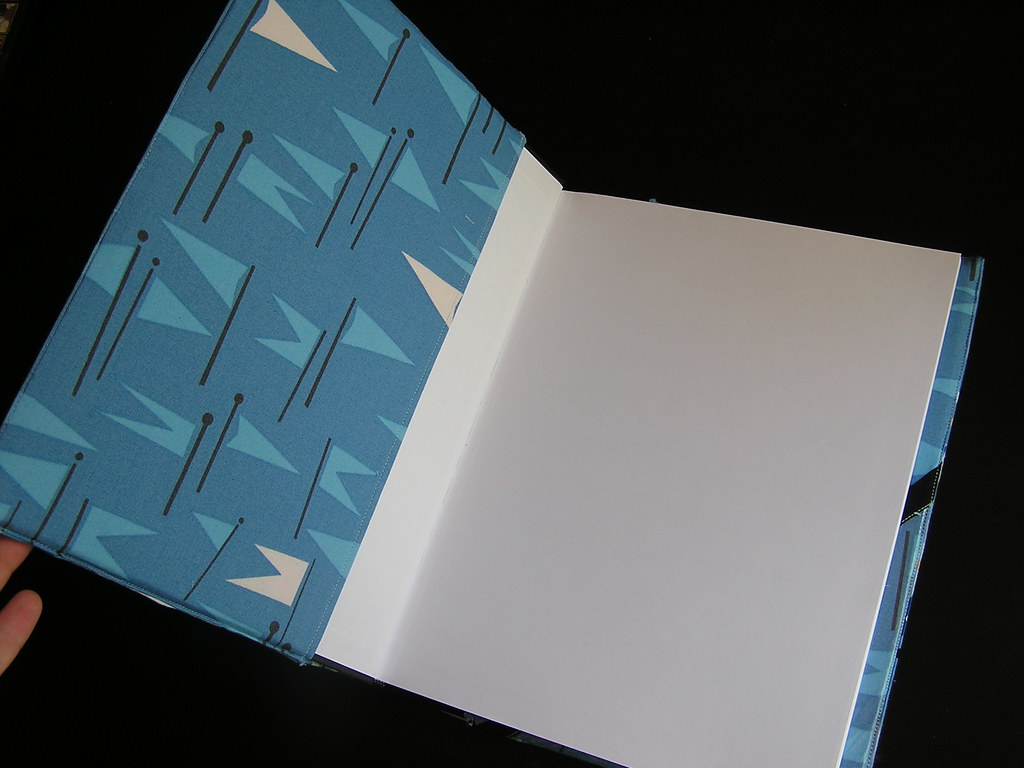
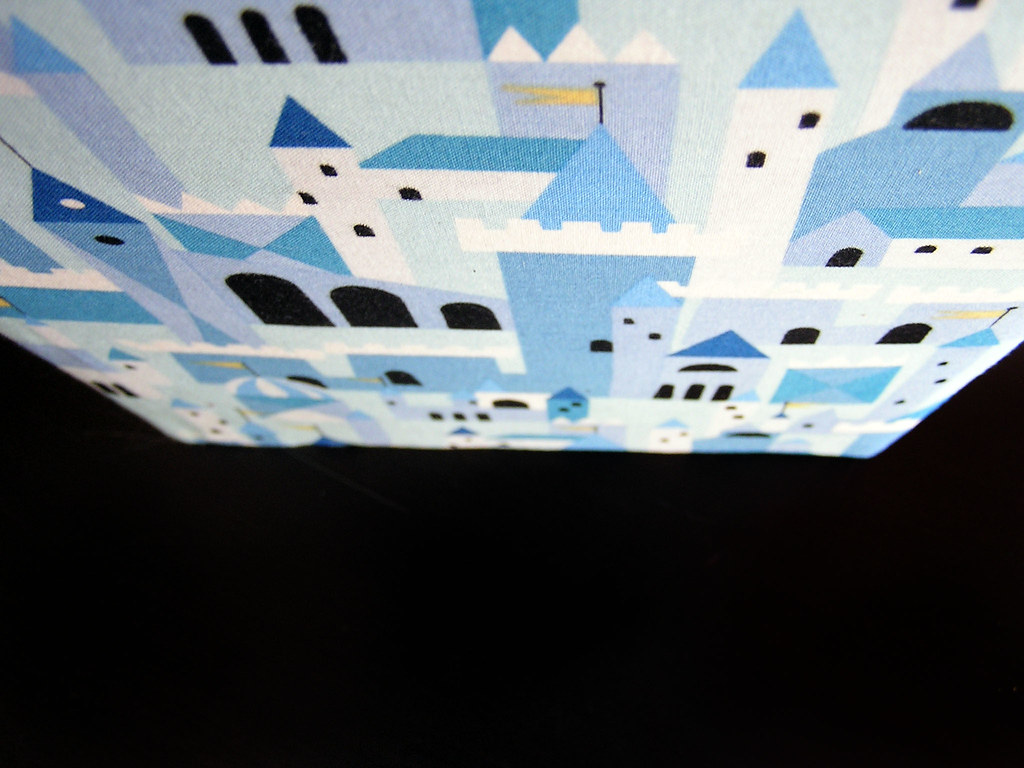
Isn't the fabric fabulous? I bought it from Fabricworm - beware, if you follow the link you may experience multiple fabric-gasms. Their selection of quilting fabric is toe curling. Oh and the prices are good and shipping is really fast, should you choose to consummate your newfound textile relationship.

Ok I'm going to stop comparing online fabric shopping to sex now. I'm neither as lonely nor as creepy as I sound.

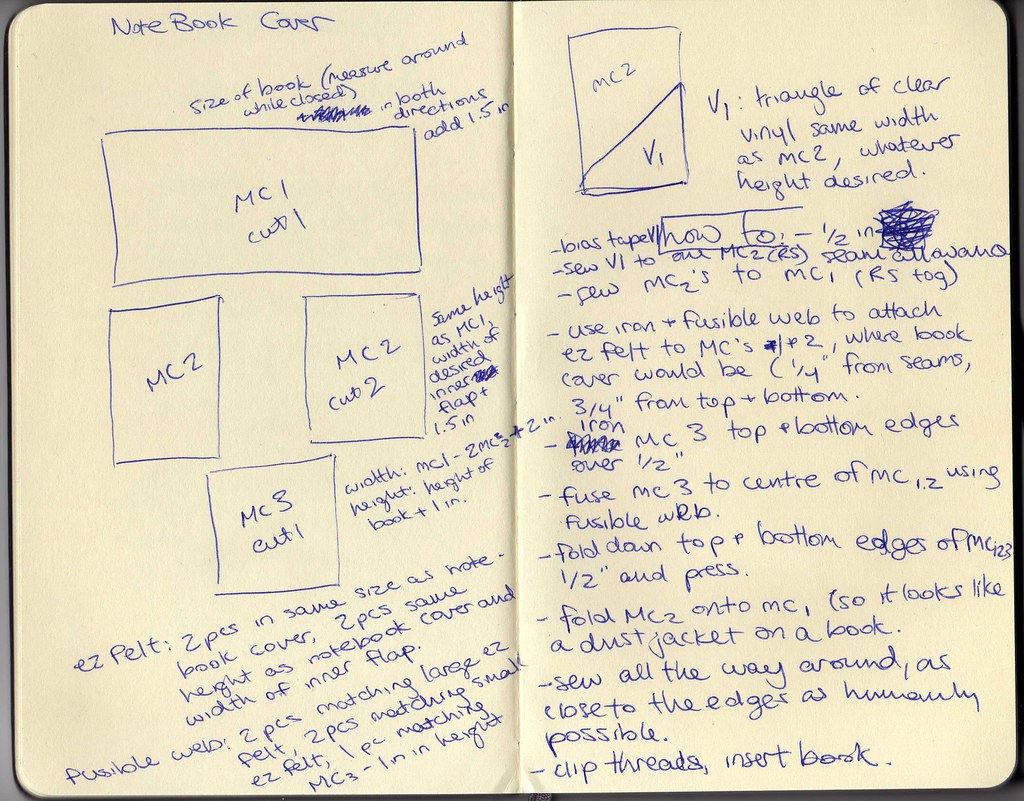
And, because I know you still want to get into my head, even after the fabric/sex thing, I thought I'd share my post-design notes for this project with you. This isn't your grandmother's hand-holdy tutorial, beware.

You need:
  • Fabric - I used 2 different fabrics but I don't care what you do. Well, I care in the sense that I think it's nice that you'd consider taking inspiration from something I made, but I'm not going to be hurt if you don't listen to what I tell you to do.
  • Coordinating extra-wide double-fold bias tape.
  • Clear vinyl. I used a bag that some baby thing-or-other was packaged in.
  • EZfelt. It's a stiff felt-like stuff made of recycled plastics. I got it at Michaels.
  • Fusible web (non-woven double sided heat fusible interfacing).
  • Thread and stuff.
Ok, this is all you get. Use the pictures above, and your imagination, to get a finished product that suits your needs. I wrote this down so I would remember what to do if I want to make another one of these bad boys - my original notes were on a scrap of EZfelt.


My brain is considerably messier than my notebook.

Wednesday, July 28, 2010

Hung Out to Dry: A Brief Tutorial

More cloth diapering stuff folks... I'll stop soon, I promise.

One of the drawbacks of wool soakers (for more on wool soakers as diaper covers, see my previous post) is that you need to get them good and dry between uses. We have five, which we rotate through each diaper change. Having 5 diaper covers on the go, some of which may be damp and need to dry before their next turn, can be a space issue. You can't stuff them in a drawer because they won't get dry (or at least they won't in my humid basement nursery) but leaving them lying all over the place looks untidy and leaves them vulnerable to cat-related abuse. The only option for me was to hang them up.


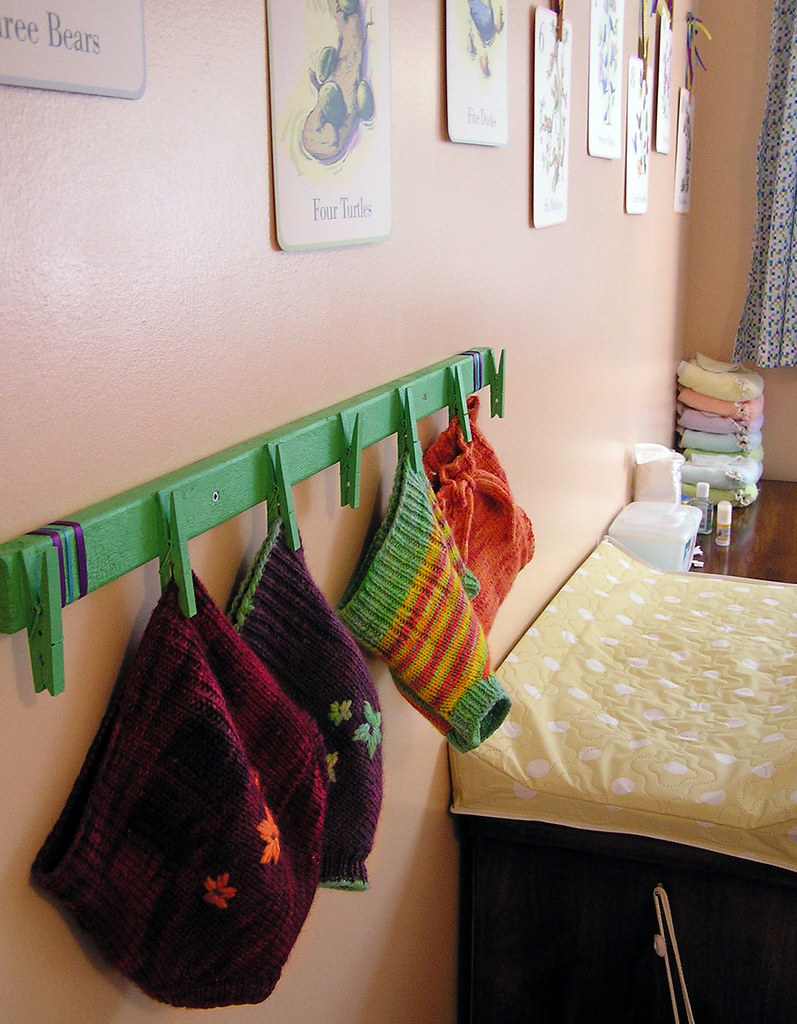
This little rack was about a half hour project, if you don't count the time the paint took to dry. I used:

  • 3/4" x 2" strip of wood, cut to about 31" (the length is up to you - I had this bit of wood lying around and as I don't have a saw, it stayed the length it was).
  • 7 Wooden clothes pegs (or whatever number suites your needs - odd numbers are more aesthetically pleasing than even numbers).
  • Hot glue, wood glue, or craft glue.
  • Paint (I used acrylic).
  • Ribbon for embellishment, if that's your thing.
  • Drill and screws.
Measure out where you want your clothes pegs to be and mark your strip of wood. Glue the pegs to the wood, making the top of the peg flush with the top of the wood. I used hot glue because I am into instant gratification.
Once the glue is dry, paint! I recommend a coat of white as a primer if you are doing a light or bright colour, especially if your bit of wood, like mine, has manufacturey details stamped on it. When the paint is good and dry, embellish your rack (lol... Rack... Sorry, I lack maturity and self control) in whatever way would suit your room decor. I wrapped ribbon around mine and glued the ends down on the back, which gives a nice bit of colour and texture and also coordinates with R's floral mobile and the wall decor.
Drill two starter holes so you don't bugger up all your hard work trying to force bits of metal through the wood, and fix the rack to the wall with screws. This rack is only meant to hold lightweight objects, and weighs almost nothing itself, so don't worry too much about drywall screws and the like.


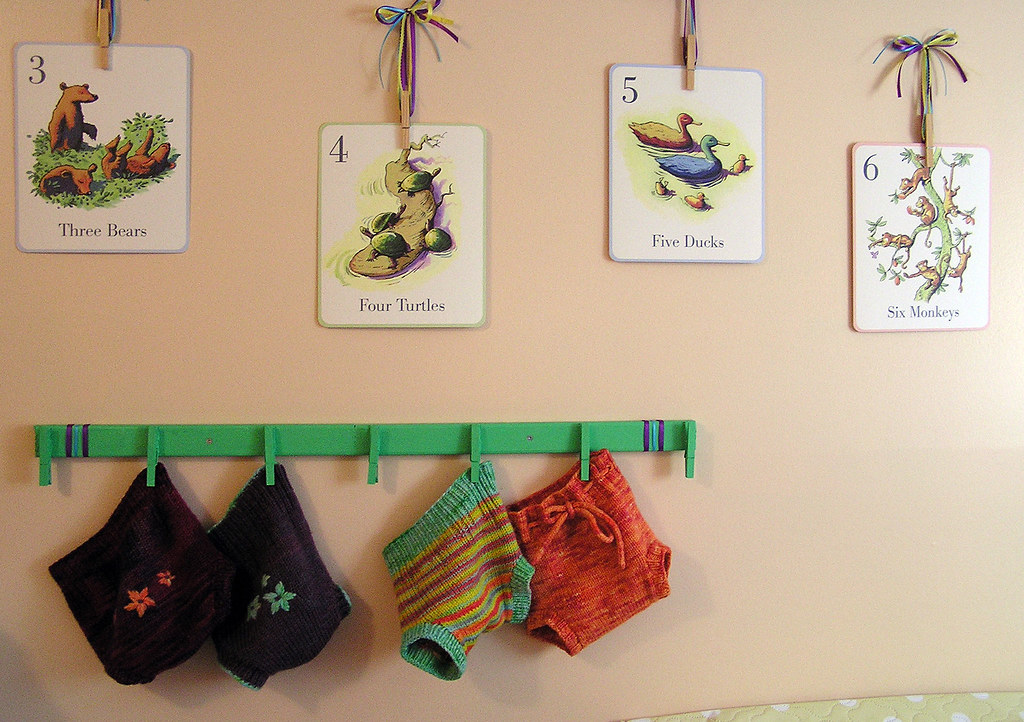
Yay! I would guess this project cost about three dollars, factoring in all the materials, but if you are like me and have this sort of stuff lying around, it's free! I love it for hanging soakers, but it would be a really cute way of storing hats and coats or dresses or any other adorable baby clothes that need a home and want to be displayed.

By the way, how much do you love those numbered cards on the wall above the soakers! The illustrations are ridiculously sweet and the cards are sturdy enough that they can be used as a teaching tool when your little one is learning to count!


They are the Animal Counting Cards by eeBoo, an amazing brand of beautiful kids' toys and learning aids. Ours were a gift bought at Sprouts, a lovely boutique in downtown Victoria. I can't afford their stuff, but maybe you can! Their selection of high quality children's items is delightful. I want every single thing they sell.

Thursday, July 15, 2010

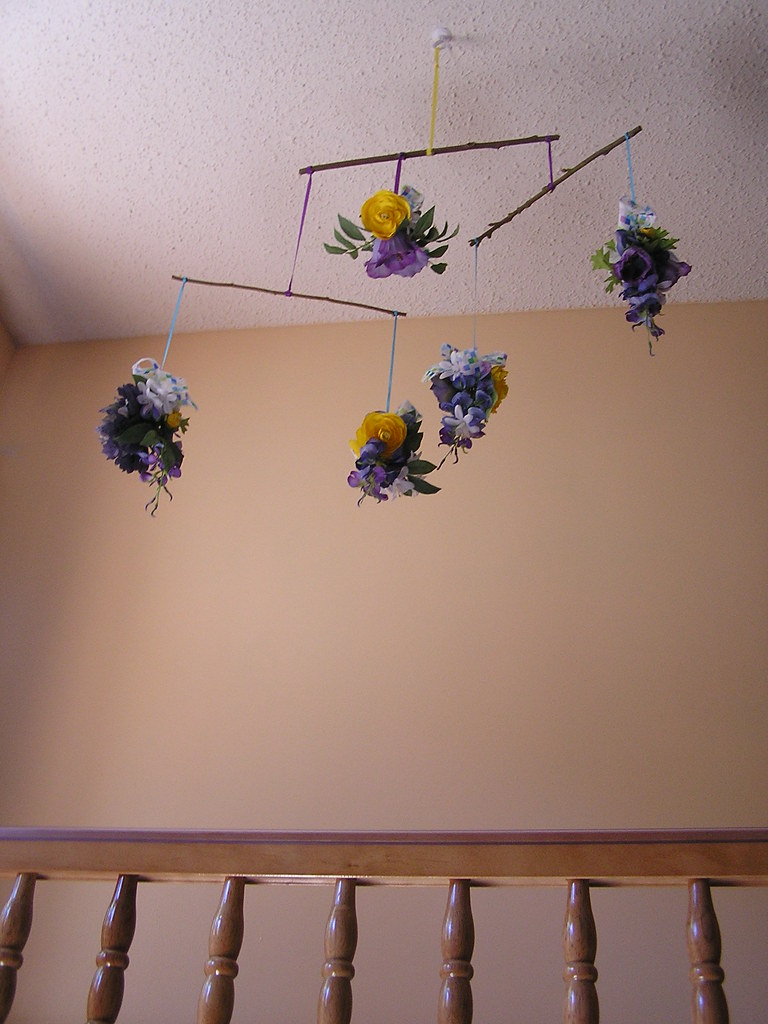
Flower Mobile Tutorial

I promised to write this up months and months ago but I never did. Bad me.

When we were decorating R's room I really wanted to avoid the pretty pink princess look. I'm just not feminine like that, and cute little girly things tend to get my hackles up. Instead, I chose to focus on a palette of greens, blues, purples and yellow. I love hanging mobiles and they look so sweet over a crib, but most of the ones I have seen in stores are tiny and cheap and tacky and attach to the side of the crib, or are stunning but prohibitively expensive. I wanted something with a little more oomph but on the cheap. And so, the hanging bouquet mobile was born.


Isn't that just the worst paint colour by the way? It looks like that 'flesh tone' coloured pencil crayon that doesn't remotely resemble the skin of anyone you have ever met.

To make the mobile you need:
  • a large bouquet of fake flowers, some of which need to have long, fake wood stems.
  • ribbon in colours that coordinate with your flowers
  • hot glue
  • sturdy wire cutters (or wimpy little ones augmented by determination, elbow grease, and muttered profanities)
First you need to get all the flowers and leaves off the stems. Some will just pop off, some need to be snipped. Make sure you leave little stems on them so you have something to glue together. Separate your flowers and leaves into two piles and select some good stems to use as the 'branches' of your mobile. You need one sturdy one for the top and two lighter ones, shorter than the first and of different lengths, for the bottom tier.


Begin assembling flowers and leaves however you like them, using lots and lots of hot glue (seriously, go nuts) to secure them together. If you are gluing flowers with very thin plastic stems, be aware that the glue may be hot enough to melt the plastic. Sometimes I found it worked best to apply the glue, let it cool quite a bit, and then smush the little stems into the glue blobs.

I used clusters of wisteria as a base and built corsage shaped flower clusters. Little flower spheres would be super cute and have a more modern look. Don't forget leaves! I topped my clusters off with a bow using torn strips of fabric left over from the curtains and bed skirt I made. This really pulled the whole room together. However, using the same ribbons as you string the mobile with would be very pretty as well.


Make five clusters: two for each of the bottom branches and one for the middle of the top branch. After the glue has cooled all the way, do your best to remove all those nasty little hot glue cobwebs clinging to your flowers.

Stringing the mobile is the hardest part. I tried it with fishing wire, but I found that this particular mobile looks goofy if you can't see what's holding it together. So I left it on the table for a while to rethink my options and the cat came in and chewed up all the fishing wire. It wasn't meant to be.

Start with your bottom tier branches. Choose two bunches of flowers and tie a length of ribbon to them and then to the ends of the branch. Don't make the lengths of ribbon too even unless your flower clusters are very symmetrical and you are aiming for a geometric effect. Mine had an inch or two of difference, giving the mobile a more natural look. And yeah I know it isn't exactly natural for bunches of flowers to hang from flying branches. You know what I mean. Hide the knot on the branch by wrapping the loose end of the ribbon over it and securing it with a dot of glue.

Once your bottom branches have their flowers attached, find the midpoint of the branch by balancing it on your finger. You don't want it to tip even a little bit in either direction - it should sit perfectly horizontally on the tip of your finger. Tie one end of a strip of ribbon around this point and hold it up to test the balance. Make any adjustments necessary and then put a tiny dot of glue on either side of the knot so the branch can't slide. Do this for both bottom branches.

Secure the bottom branch ribbons to the ends of the top branch the same way you tied the flowers to the bottom branch. You will want the ribbons to be quite different in length (a few inches). Hang one side, hold it up and see if you like it, then do the other. Make sure your bottom branches can spin without getting hung up in each other's ribbons. If the bottom branches are too long you may run into this problem.

Using a fairly short bit of ribbon, tie the fifth flower cluster to the top branch. It needn't be in the dead centre - play around with the placement and do what looks best. Make sure it doesn't interfere with the other branches and ribbons.

Find the balance point of the top branch and tie a ribbon there, just like you did with the lower branches. A loop in the other end of the ribbon can be used to hang your mobile. Make sure that it is secure if you are hanging it over a crib - use the proper hardware for your ceiling. You would feel like a terrible parent and a failed crafter if it fell on your kid. Don't hang it low enough that an older baby could grab it, and be mindful of the fact that you do need to be able to lean over the crib without getting bopped in the face by an errant bunch of flowers.


R loves this mobile. It's very large and striking, and it absolutely mesmerizes her when I give it a spin. Have fun!

Friday, June 18, 2010

The ugly shirt continues to provide

While I was cutting out the pieces for the baby toy in the last post I looked at my pattern pieces and thought "Hey! Looks like Legwarmies!" In saying 'legwarmies' I am not trying to be cute; it's a sweet baby leg warmer knitting pattern found here. I was about halfway through making them and they were very present on my mind because they were working up fabulously. Anyway, I decided to make some legwarmers for R. Here's what I did (you'll need an unwanted knit shirt with cuffs, or, of course, some fabric). I love the utility of this project. They make dresses possible on cold days, they don't have to come off for a diaper change, but they do come off easily if it warms up while you are out and about.

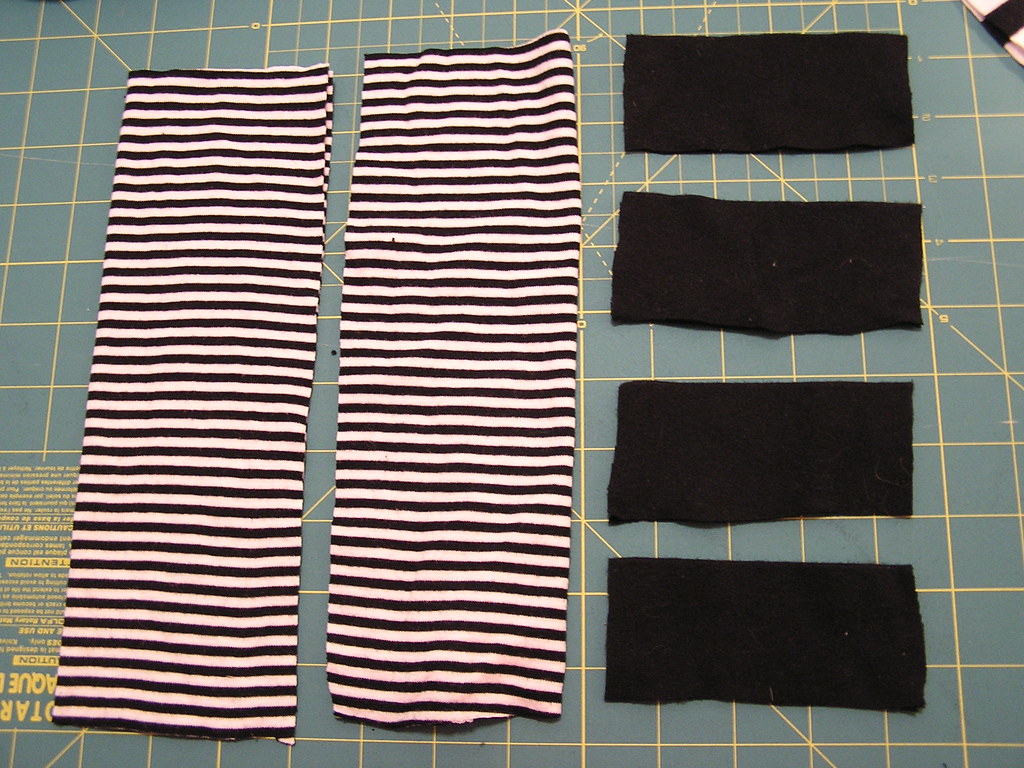
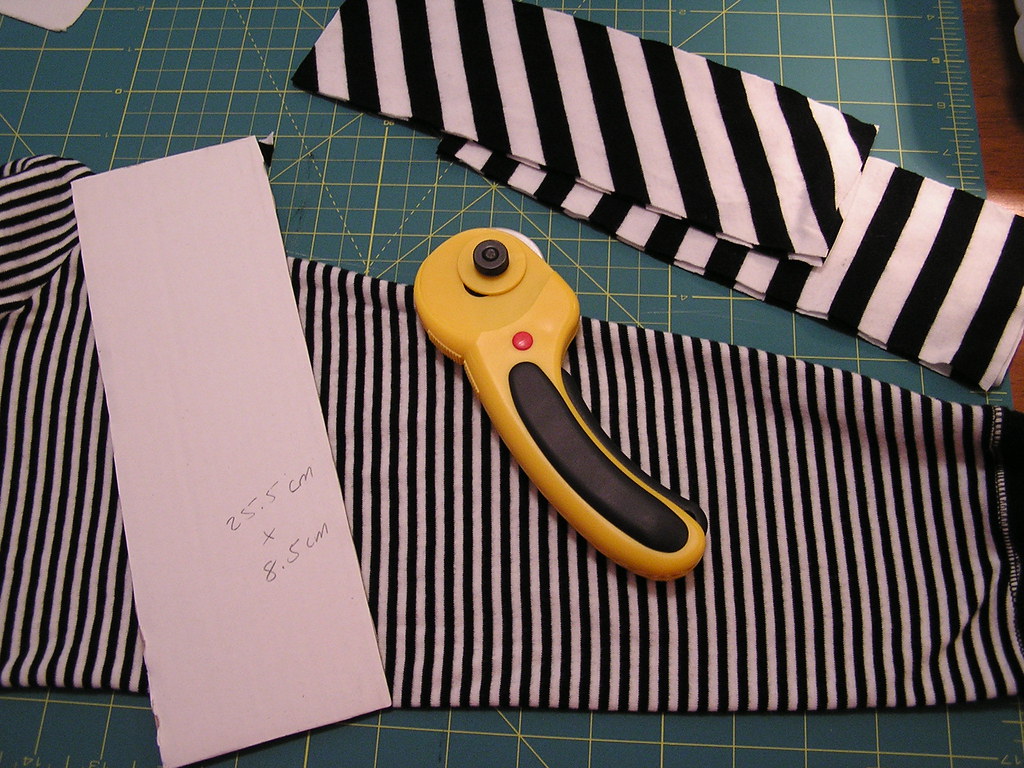
Take your 8.5 X 25.5 cm bit of cardboard from the previous project and use it to cut two pieces of knit fabric on the fold (so they are actually 17 cm wide). Cut off the cuffs of your shirt, cut the seams off, and then cut them into two. They will be folded (like they were when they were cuffs). Like this: (all these pieces are folded)


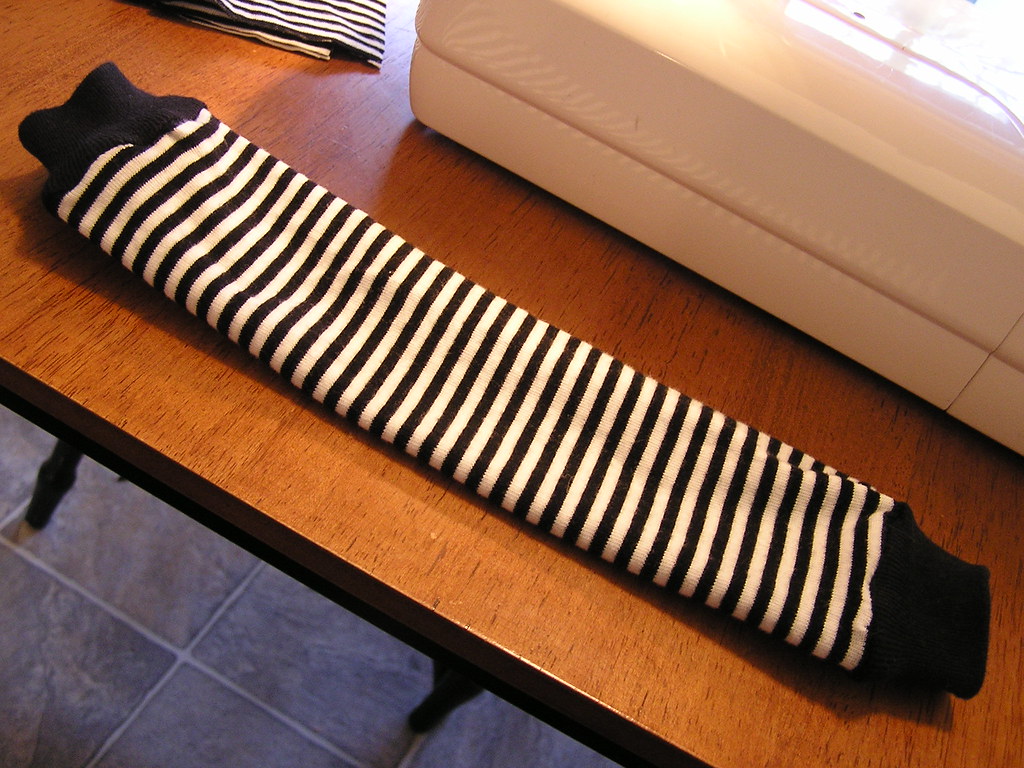
Stretch out the cuff pieces so they are the same length as the short ends of the leg warmers and sew them on, enclosed-cuff-style. I recommend lots of pins to keep everything even; the stretched cuffs can be tricksy.


You will have a little two ended sleevey thing, comme ca:


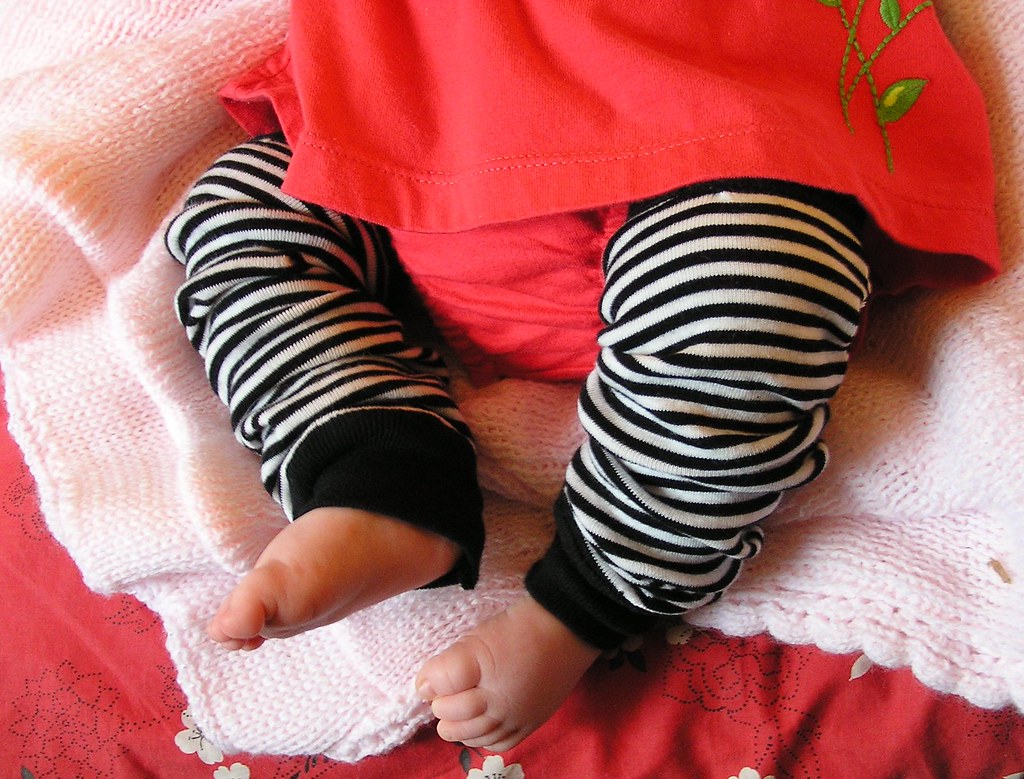
Make another and apply them to the adorable infant of your choosing. Cute poses are pretty easy to photograph, what with the proximity of sweet little baby feet. Aww....


Are you in love yet? I like that they are sort of Tim Burton-esque. I bet if Jack and Sally or Victor and Victoria had babies and put them in leg warmers, these would be the ones.

Oh, and the knitted Legwarmies are also a success.

Saturday, June 12, 2010

A bright future for an ugly shirt

I bought a set of fleece pyjama pants to wear in the hospital when R was born, and they came with an enormous black and white striped shirt. The thing was hideous on me (Horizontal stripes on my pregnant 2X self. Seriously people... why?) but the fabric was a super snuggly soft 1X1 rib in 100% cotton, so I kept it around, just in case. When I read that really young babies have trouble distinguishing anything other than very high colour contrast, and hence love graphic black and white toys, I knew my convict-esque shirt had a future. I set out to make a simple cuddly sphere for her to drool all over. She loves it so much I thought I'd share.

First, cut a piece of cardboard into a 25.5 x 8.5 cm rectangle (the short end is exactly one third the length of the long side) to use as the pattern. Using this as a guide, cut 2 pieces of t-shirt on the bias. I think if your fabric is a stocking stitch knit rather than a rib you could cut on grain, but a rib stretches too unevenly to cut on the grain for this project. Try it if you like (I did, with unspectacular results) but I think you'll have better luck on the bias.


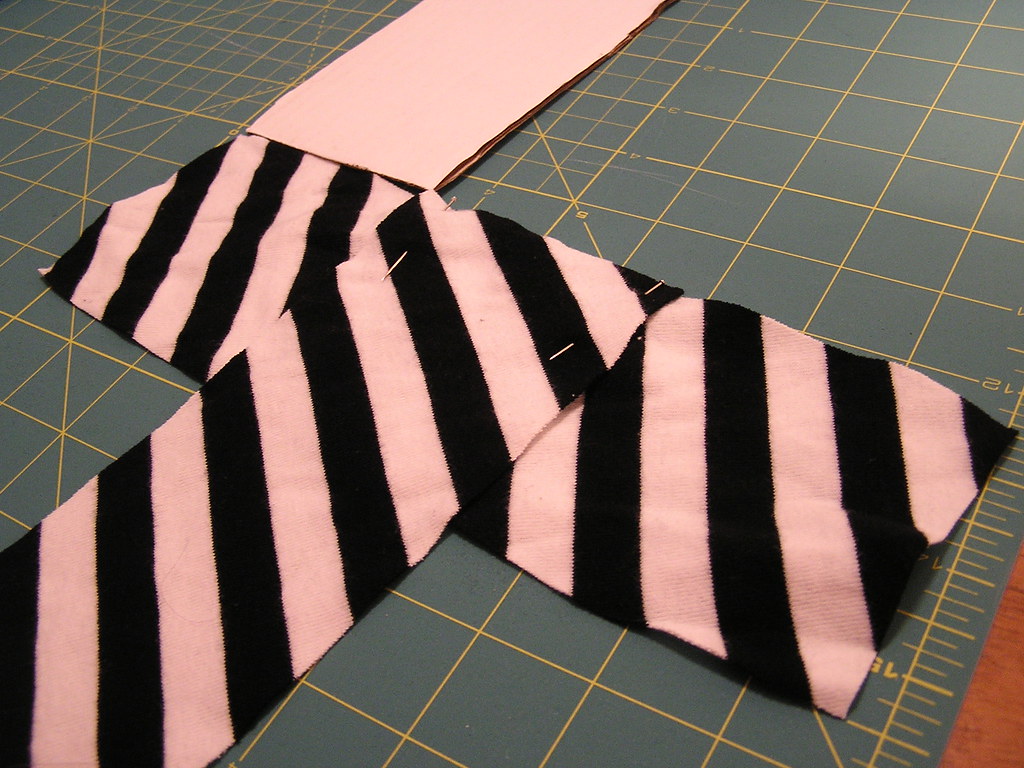
Using the short end of your cardboard pattern, measure one third of the way along the long side of one of your fabric rectangles. Position the short side of the other piece along this long side, covering the middle third of the piece and making a T shape. Pin. Wow... that makes no sense. Look at the picture OK?


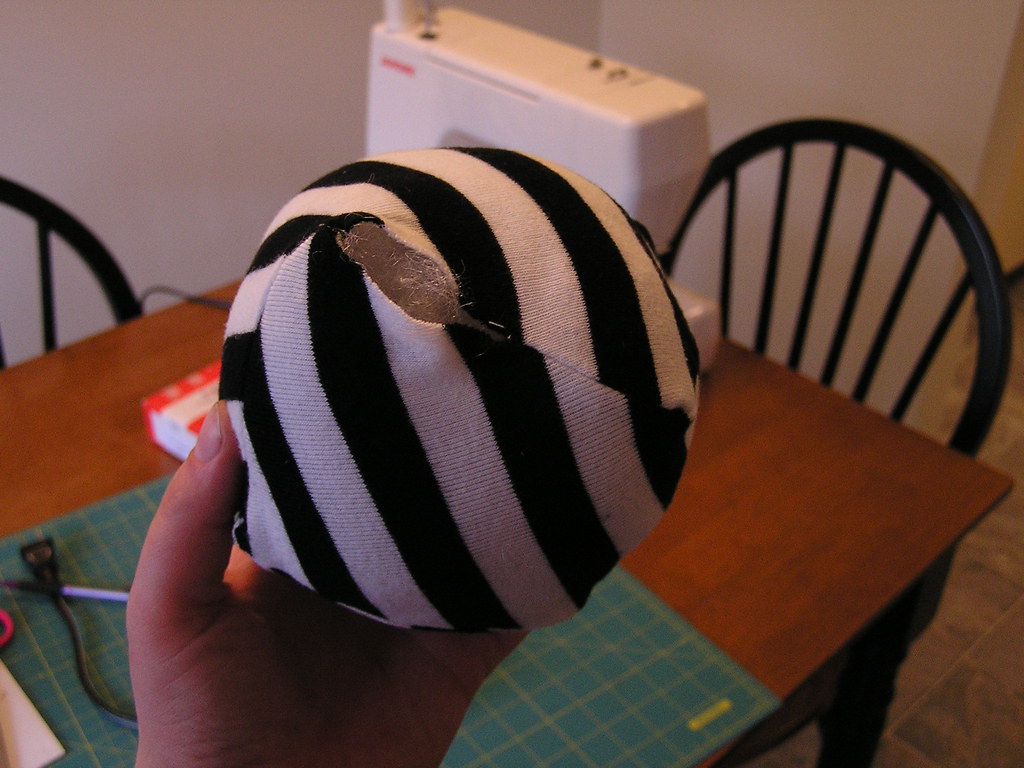
Sew along that pinned edgeuntil just before you reach the end of the short side of the top piece of fabric. Re-align the edges of the 2 pieces, and continue sewing around, matching up the edges in thirds as you go. Essentially you are making a cube - each rectangle makes up 3 sides. Leave a smallish hole at the end of your seam. Turn, and stuff.


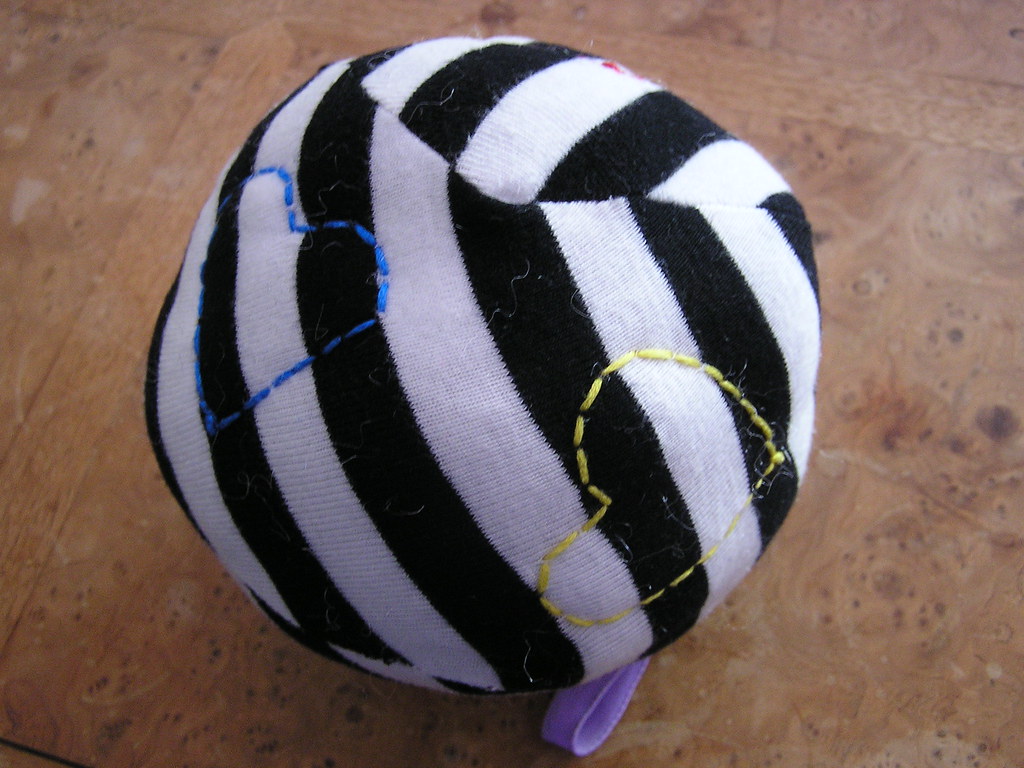
Sew up the hole, inserting a loop of ribbon so you can hang the toy or hook it to things with a plastic link. I embroidered some hearts in red, blue, and yellow on mine. I forgot to take a picture of the finished product when it was new, and it's had some love over the past few months, but here's what it looks like now:


R loves this thing. It's really squashy so she has been able to grab onto it with her clumsy little mitts ever since she first began to show interest in holding onto her toys. Mostly now she tries to shove it in her mouth, which is pretty fun to watch as it's almost as big as her head.

I think this fabric ball is a great, versatile toy because it can be simply modified with greatly varying results,  and doesn't take as much sewing as a 6 piece stuffed cube/ball/thing. Make it in a non-stretchy fabric for a more cube shaped toy, or stuff it with a cube of foam instead of polyfill if you want something that would work like a building block. Throw a few jingle bells or some crinkled up cellophane inside so it makes sounds when baby plays with it. Use different textured fabrics like corduroy or vinyl, or sew tabs of ribbon in all the seams to give it tactile interest. Put a securely sewn sachet of dried lavender inside to stimulate baby's sense of smell. Have fun with it and baby will too!

Monday, March 29, 2010

Bathrobe to Burp Cloths!

J's old bathrobe was replaced this Christmas (thanks Mum and Dad!) which is a good thing. It was getting pretty ratty and I may have washed it with something red at one point, leaving a few pink splotches. It was made of a pretty sturdy white 100% cotton terry-cloth-type-stuff with loops on one side and a velvety reverse. I decided it was too good to waste, so I stuck it in a corner of the bedroom floor (naturally, a fantastic place to store potentially recyclable clothing) and waited. When I was in my nesting frenzy before R arrived I realized I had no burp cloths! The horror! I was really pleased with the transformation.


You will need:
  • Fabric. An old terry bathrobe will yield loads of cute cloths. Old towels (provided they aren't super scratchy) would be great as well. Anything soft and absorbent with large flat areas will serve you well. I really recommend making this a recycling project - cloths like these get a lot of use and won't stay pristine for long. It's really satisfying to get so much mileage out of fabric you would otherwise throw out.
  • Sewing machine with fun stitch patterns. If you are lucky enough to have a serger, give it to me! I mean... crack it out. It's worth the threading time to avoid fraying later.
  • Fun thread colours. You will go through lots of thread on this project, so it's a great way to use up those half spools that build up over the years.
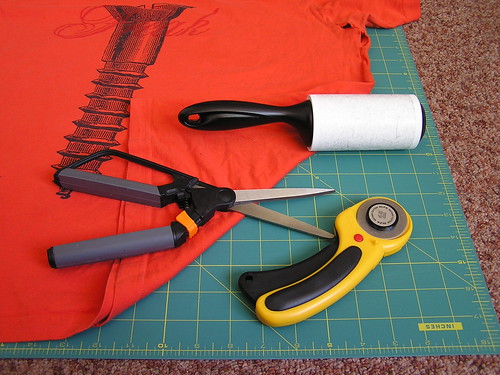
  • Lint roller for cleanup. Terry cloth makes a mess. Velvety terry cloth is even worse, as it makes little fluffy bits that stick to you.
Start by tearing your fabric into rectangles. I tore the large panels of the robe into wide strips and then divided those strips into smaller sections. I didn't bother making all the rectangles the same size, preferring to get more out of my robe rather than go for uniformity. If I was making these as a gift I would have been more diligent on that front.
Cut off all the frayed bits. Now you have loads of fluffies to pick up with your lint roller.
If you have the tools, serge the edges. If you don't, join the club.
If your fabric has a soft side, turn that side down and use a wide stitch (like the diamond one I used) to sew a 1/2 inch hem the whole way round. Turn it up as you go, and don't sew right on the edge. You needn't be too precise, they'll look great no matter what. When you get to the corners clip a bit off at a 45 degree angle and overlap the two sides, sewing them down. Make sure the corners are sewn well down or they will fray with frequent washing. Like so:


Use the same stitch to sew down the loose edge. Centre the needle over the edge completely covering it with stitching. This locks it down nicely and keeps it from fraying. I used two different colours of thread, one for each line of stitching. I really like how it looks - just ornamental enough, but not too frilly.


You're done! Snip your thread tails and go :) Take a pretty picture first though, because from this point on your pretty project will be covered in spit-up and drool.

Friday, December 11, 2009

So I Lied

I said I'd be posting more but the evidence suggests I am a liar.

In my favour, we found out shortly after the last post that we were accepted into a housing co-op that we had been hoping to get into for ages. So, the last weeks have been spent moving. I actually sort of like moving - I love the chance it gives you to go through everything and see what you have and de-clutter. I think I am the opposite of a hoarder - I get rid of everything I might not need, and then I ALWAYS need it later. Oh well, It gives me the mental workout of finding creative solutions for not having the things I need. Right? Yep.

So, I love this new place. J measures floorplans of houses for a living and he deduced that we have actually doubled our living space in this new home. We have a room for the baby, a dining area, so much kitchen storage, an outdoor storage room, and, I think best of all, a little patio with a garden plot! Come spring I will no doubt be posting the great backyard revamp (currently it is covered in moss, overgrown with plants that I hate, and generally a little inhospitable).

One thing I do miss, however, is the space the old kitchen had for spices. In memoriam, I shall post photos of my old spice-space. It was my domestic pride and joy. My little spice racks are still out though, which is some consolation.


The bottles are old chemical supply bottles that my dad acquired from the high school lab where he used to teach chemistry. If you are able to find things like this, I strongly recommend replacing the corks. You never know what was in an old bottle and you really don't want to eat some of it. New corks can be purchased at hardware stores, generally in the aisle of bulk bits-and-bobs. Be prepared for a shock, those things cost a FORTUNE.

I labelled my spices by choosing a nice font and colour and printing up a list of what I needed. I then stuck double sided mounting tape (the foam stuff) on the back of the paper where the words were, cut them out, peeled the other side off the tape, and stuck them on the bottles. Not very tricky eh? Thin double-sided tape would work just as well and probably get less damage over time (as it wouldn't catch on things), but I like the way the mounting tape looks. It is a great way to make labels if you haven't been blessed with one of those wicked labelling gadgets. Very cheap and easy.

RIP old spice display...
It's actually better for many of the spices to stay out of the light anyway, so my cupboard isn't all that bad, I guess.

Thursday, May 21, 2009

T-Shirt Yarn Tutorial

Wanna make some awesome yarn out of old t-shirts?
It's great for all sorts of projects, from bags to bathmats and beyond. It's also a fantastic way to recycle the old t-shirts that you and I both know you have stuffed at the back of a closet. You will need
fabric scissors and a flat surface on which to work (I use the floor... ps. check out my heinously ugly carpet. It reminds me of ground beef). For faster, smoother cutting use a rotary cutter and a self healing mat. You might also want a lint roller. You will see why later.

tshirt yarn 2

Step 1.
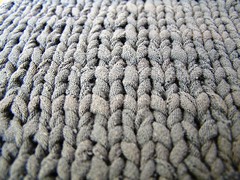
Choose your t-shirt wisely. I am of the opinion that no side seams is darn near a must. A t-shirt with side seams, no matter how you cut it up, will knit or crochet to make a fabric with little bits sticking out of it. Like the pic on the top. A seamless t-shirt will knit up smooth, like the one on the bottom. Seams can also create major weak points in the yarn, which is no fun at all. If you are as anti-seam as I am, look for men's shirts (preferably in really large sizes). They are far less likely to have seams.


pics 018 pics 019

You also need to avoid t's with too much of a design printed on them, as it will likely prevent the yarn from curling nicely. Make sure the fabric is regular t-shirt fabric, which looks like tiny stocking stitch, rather than a micro-rib fabric. Other than the fabric, the orange shirt I will use in this tutorial is all wrong. It has side seams, and a design on the front. But hey, it's what I had on hand.

Step 2.
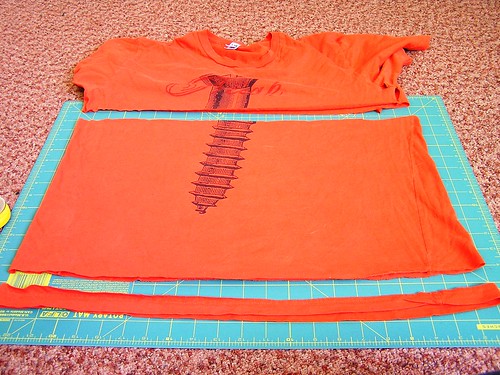
Start by laying the shirt out nice and flat, removing any wrinkles from both the top and bottom layer. Using your rotary cutter or your scissors, cut off the bottom hem and the top, below the armpits. If there are armpit holes, make sure you cut below them. This shirt had major armpit holes. It also essentially said "Screw Freak" on it. I only figured that out a few months ago. Hence the reason why I am chopping it up rather than wearing it.

tshirt yarn 4

Step 3.
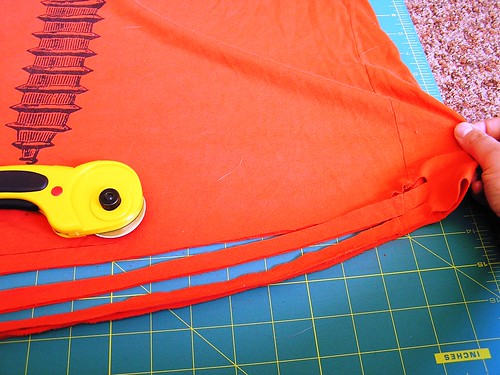
Cut a strip about 1/2 inch wide, parallel with the bottom of the fabric. Leave about 1 1/2 inches uncut on one side. If you are using a rotary cutter and you aren't used to cutting stretchy fabrics with it, take note. It will create a much better, unbroken cut if you gently tug the fabric AWAY from the cutter (in the direction you are cutting towards). Every time you cut a strip, pull it away from the main body of the fabric a bit, to check for any bits that didn't cut. If you are using scissors (which is just fine, but a bit slower) try to cut a smooth line so there are no little nicks or shaggy bits hanging off.


tshirt yarn 6

Step 4.
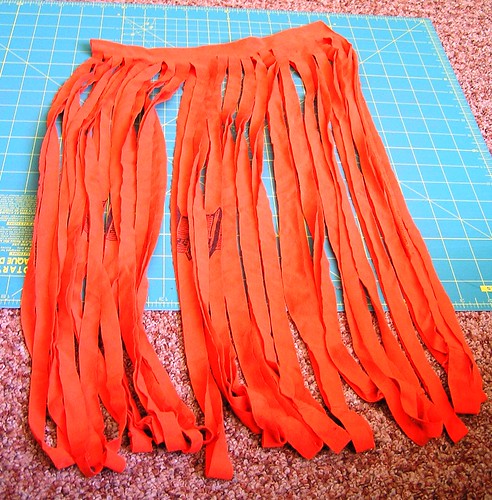
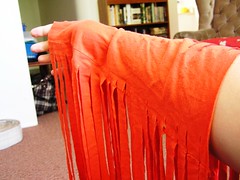
Keep cutting until the whole shirt is in ribbons, with one edge still intact. Try to keep your cuts relatively parallel, but don't sweat it if they are a bit wiggly. The yarn will still be good, and life goes on. Try not to let the strips get any smaller that 1/4 inch, or there will be a good chance that they break later on. When all the cutting is done I like to hold it up and wave it around and say "Look! A Hula skirt!" My husband can verify this. You can do it at your own discretion.

tshirt yarn 8

Step 5.
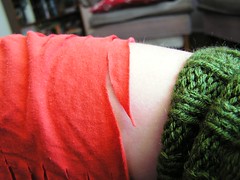
Open up the fabric and drape it over your arm. A sleeve ironing board would also work well, but I bet your arm is easier to find! Begin by cutting a wedge at one end (I start at my... erm... elbow pit. Is there a real name for that?) of the uncut part of the fabric, joining it with the first strip cut on one side. The goal is to make a t-shirt spiral, so you have a continuous loop of yarn. Please, please don't use the rotary cutter for this....Your mother would kill me if she thought I suggested something like that.

tshirt yarn 9 tshirt yarn 10

Step 6.
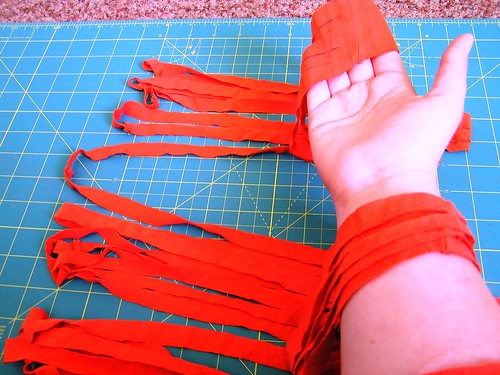
Continue cutting the uncut fabric. Always cut from the strip closest to your elbow on one side of the uncut space to the closest strip on the other side. If you goof this up you will sever your continuous strand and end up with a bunch of useless t-shirt rings. Ask me how I know this... Verify that the loop is continuous every few cuts by pushing the cut loops toward your elbow and keeping the rest closer to your hand. If the two sections of hanging loops are connected by a single strand, everything is OK.

tshirt yarn 12

Step 7.
Continue Cutting until you run out of strips. Taper the final one off in the same (or rather the opposite, I guess) way as you started cutting way back at the beginning.

Step 8.
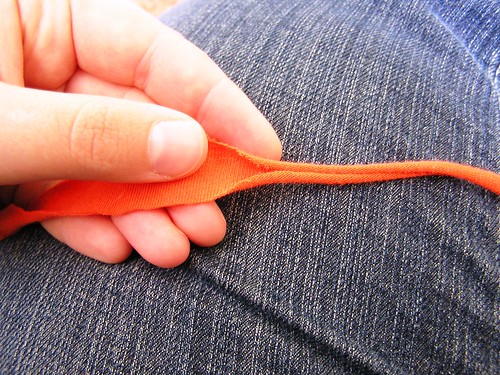
Next we have to stretch the yarn, which turns it from something that looks like ribbon into something that looks like string. Starting at one end, hold the strand gently but firmly in one hand with your thumb on the stocking stitch side of the fabric
(originally the outside of the t-shirt). Pull it through your fingers with your other hand, keeping it feeding past your thumb. It may flip over and you will have to readjust it every once in a while. Try to keep it stocking-side-up and feeding under your thumb; it doesn't make a massive difference, but it does help and is worth the very little effort it takes. Stretch it hard enough to curl, but not hard enough to break. You will be able to feel this correct tension easily.

tshirt yarn 15

Once you have stretched the entire length of the yarn, do it again! You will want to stretch it several times. I like to do about 4. You don't need to worry about holding it flat with your thumb after the first time. If you did decide to use a shirt with side seams, I do not recommend stretching the seam points. In all likelihood the stitching will undo and you will end up with a bunch of short yarn noodles. You'll be frustrated. Trust me.
Step 9.
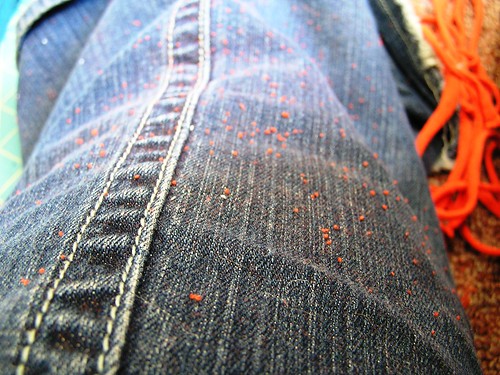
Clean up! When you are done you will be COVERED in little bits of t-shirt.
tshirt yarn 21

If you didn't have a lint roller at the beginning of all this, you may be regretting it now. Happy cleaning, and happy knitting/crocheting! I would love to see what you make!